


Call Us Now
Phone #1: +86
18206258368Phone #1: +86 18941192030
Author: Site Editor Publish Time: 2026-09-06 Origin: Site

Selecting the right physical dimensions for a cleansing product is a critical development decision. It directly impacts end-user satisfaction, unit economics, and repeat purchase rates in a highly competitive beauty market. Brands face a tough evaluation challenge during this process. You must carefully balance a luxurious user feel against practical realities. Absorption rates, wash durability, and strict packaging constraints all require careful consideration. A poor choice here can frustrate buyers and damage product reputation.
This article provides a technical, evidence-based framework for evaluating core product attributes. We will help you navigate production choices to select the optimal size and thickness for your specific target market. You will learn how to match surface area to daily user routines. Furthermore, we decode the long-term impact of material construction. Ultimately, these insights will streamline your manufacturing decisions and elevate your final cosmetic accessory.
Before reviewing fabric swatches, you must analyze everyday consumer habits. Assessing the target audience routine prevents costly design mistakes early in development. Users applying heavy, waterproof cosmetics demand entirely different solutions than those using light, daily skincare. Heavy makeup requires larger surface areas to prevent smearing cosmetic residue across the skin. Smaller pads force users to use multiple pieces, which disrupts their evening routine.
Next, evaluate the liquid product pairing. A reusable makeup remover pad behaves differently depending on the solvent. Micellar water flows easily and requires tight fibers to prevent excessive dripping. Heavy cleansing balms demand textured surfaces, like terry cloth, to physically lift oils. Toners need thin, non-absorbent materials to deposit expensive active ingredients onto the skin rather than trapping them inside the fabric core.
Finally, clearly define your eco-friendly versus performance claims. Positioning a product as a zero-waste alternative carries specific manufacturing burdens. The durability must physically outlast the environmental cost of production. A pad falling apart after ten washes creates more ecological damage than disposable cotton rounds. You must engineer the product to withstand dozens of aggressive wash cycles.
Common Mistake: Brands often neglect to test their prototypes against waterproof mascara. Always conduct real-world trials to observe how fibers grip stubborn pigments.
Surface area directly dictates how consumers interact during their skincare regimen. Selecting a standard versus custom diameter alters both user ergonomics and manufacturing waste.
Standard 6cm to 7cm (2.3 to 2.7 inches) designs dominate the current retail market. They offer distinct advantages and limitations.
Oversized 8cm to 10cm+ (3.1 to 4.0+ inches) formats provide a completely different tactile experience. They cater to consumers seeking speed and efficiency.
Shape considerations also play a massive role in factory production. The round shape remains the industry standard. It minimizes fabric waste during automated die-cutting processes. However, alternative shapes provide functional upgrades. Teardrop or square edges offer superior physical access to inner eye corners. Consumers often praise pointed edges for precise eyeliner correction.
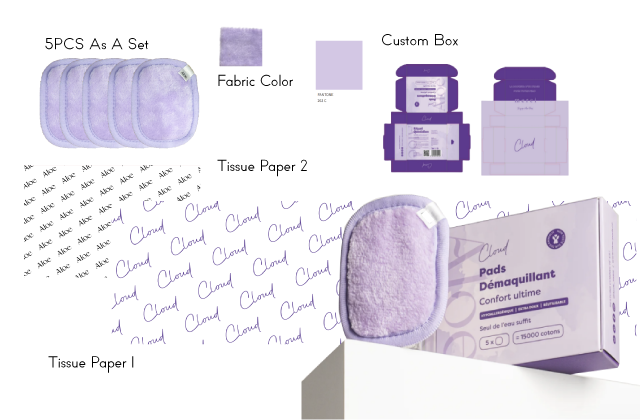
Understanding Ply and GSM (Grams per Square Meter) is non-negotiable for product developers. These metrics determine how makeup remover puff specifications are actually measured on the factory floor. Higher GSM translates to denser, heavier fabric. Adding multiple plies (layers) creates a thicker final product.
Thin or single-ply pads serve a specific, highly requested function. They minimize liquid product waste beautifully. This makes them ideal companions for expensive toners or liquid removers. They are highly flexible and contour easily to the face. However, they carry significant drawbacks. Single-ply fabrics are highly prone to curling after machine washing. They also present a higher risk of physical skin friction because the user presses their fingers closer to their face.
Thick or multi-ply (2-ply to 3-ply) puffs deliver a premium, spa-like experience. They boast a luxurious hand-feel and maintain high structural integrity. They work perfectly alongside thick cleansing balms or simple water-only removal methods. The negatives involve fluid management. High liquid retention means the user inevitably wastes liquid product inside the dense core. Additionally, slower drying times drastically increase the risk of bacterial growth if users store them improperly.
Makeup Remover Puff Thickness and Performance Matrix
| Fabric Structure | GSM Range | Best Liquid Pairing | Drying Time | Skin Friction Level |
|---|---|---|---|---|
| Single-Ply | 150 - 250 | Toners, Micellar Water | Fast (2-4 hours) | Moderate to High |
| 2-Ply | 300 - 500 | Liquid Removers, Lotions | Medium (6-8 hours) | Low |
| 3-Ply (Core Insert) | 600+ | Cleansing Balms, Water-only | Slow (12+ hours) | Very Low |
Raw material selection means nothing if the construction fails. Edge finishing techniques define the actual lifespan of your accessory. You must carefully compare overlock stitching, bias binding, and ultrasonic liquid-tight joints. Overlock stitching provides flexibility and cost-effectiveness. Bias binding wraps the edge in a separate fabric strip, adding structural rigidity and a premium visual contrast. Ultrasonic sealing melts synthetic fibers together for a seamless border. A poor edge seal remains the primary cause of product failure. Fraying typically begins after just 10 to 20 domestic washes if the factory cuts corners.
Material composition realities dictate long-term performance. Bamboo velour, microfiber, and organic cotton behave entirely differently after repeated machine washing. Bamboo velour maintains softness but takes longer to dry. Organic cotton is highly breathable but tends to shrink and wrinkle. You must note an important behavioral trait regarding synthetics. Microfiber holds onto mascara and foundation stains much more aggressively than natural fibers. This requires consumers to use specialized stain removers.
Texture differentiation offers a unique selling proposition. Designing a dual-sided pad solves multiple skincare needs simultaneously. You can incorporate one terry cloth side for gentle, physical exfoliation. The reverse side can feature soft velour for sensitive areas around the eyes. Working closely with a reliable makeup remover puff supplier ensures these dual-texture designs remain securely bonded during intensive laundry cycles.
Physical product dimensions directly influence your downstream logistics. Sizing for storage solutions requires exact mathematical planning. The combined diameter and thickness of a stacked set strictly dictate your secondary packaging options. A stack of ten 3-ply pads requires a significantly taller cardboard tube than a stack of single-ply rounds.
Format requirements often dictate retail success. You are planning for multi-packs, not just individual units. Brands frequently bundle a 10-pack alongside a mesh laundry bag. Alternatively, you might design a rigid makeup remover puff,case 4 makeup remover puff case format for travel convenience. Rigid cases protect the product from bathroom humidity and appeal strongly to frequent travelers.
Shipping volume impacts your bottom line heavily. Thicker, oversized puffs drastically reduce the total number of units fitting inside a master carton. This spatial inefficiency increases freight costs per unit. You must calculate these volumetric shipping fees during the initial design phase, not after manufacturing begins.
Best Practice: Compress multi-ply pads using vacuum-sealed inner bags before packing them into master cartons. This simple factory step dramatically reduces shipping volume.
Identifying the right manufacturing partner mitigates risk. You cannot rely on unwashed samples straight from a trade show floor. Instead, implement strict testing protocols.
Compliance and certification demand rigorous verification. Brands often seek organic or sustainable claims. Verify GOTS certification for organic cotton directly with the issuing body. Confirm OEKO-TEX standard 100 certification for dyes to guarantee safety. Never accept supplier marketing materials at face value. Request the actual certificate numbers and cross-reference them online.
MOQ (Minimum Order Quantity) and scalability determine long-term viability. Evaluate whether the factory can handle custom tooling for non-standard shapes. A teardrop shape requires a custom cutting die. Ensure they can accommodate this without demanding exorbitant minimum orders. A flexible makeup remover puff manufacturer will grow alongside your brand's demand.
The optimal cosmetic pad perfectly balances surface area with appropriate fabric thickness. You must match the diameter to the specific cleansing routine your customers perform daily. Ensure the GSM maximizes physical durability without absorbing excessive amounts of expensive skincare liquids. Proper edge sealing ensures your product survives the laundry machine, protecting your brand's quality reputation.
Take action by ordering varying GSM and diameter samples from your shortlisted manufacturers immediately. Run independent, rigorous wash and liquid-absorption tests in-house. Finally, finalize your exact packaging dimensions and freight calculations before committing to any bulk production run.
A: No. While thicker puffs feel more premium and last longer, they absorb significantly more liquid makeup remover. Quality is better measured by material blend and edge-stitching integrity.
A: The industry standard for a general-use reusable pad is typically 8cm (approximately 3.15 inches) in diameter, offering a middle ground between eye contour maneuvering and full-face coverage.
A: Specify reinforced overlock stitching or ultrasonic edge sealing in your manufacturing requirements, and always advise end-users to wash the pads inside a protective mesh laundry bag.
A: It depends on the product pairing. Microfiber excels at trapping makeup with just water due to its synthetic structure, while bamboo and organic cotton are preferred by eco-conscious brands aiming for eventual biodegradability.
